

This guide will help you start and manage a team at Vancouver Ultimate. It highlights some important guidelines and provides a number of tips to help you and your players have the most fun possible in our leagues
On this page
- Communication
- After You Register Your Team
- Seeding and Scheduling
- Conflict Management
- Game reports
- Things to Know at the Field
- Captain’s Checklist for Success
First, thanks for being a captain!
Captains play a key role in any Ultimate league. Most sports have officials to help oversee games, but in Ultimate, in addition to managing and coaching their own team, a captain also needs to work with the other team's captain to manage the game. This can be challenging at times, but it can also be very rewarding. There is an opportunity to develop leadership skills and your players will appreciate your efforts—even if they don't tell you very often!
We greatly appreciate the contributions provided by all captains. We could not run our leagues without you—so again, thank you for being a captain.
At Vancouver Ultimate, captains play a few key roles:
| Leader | You are responsible for your team. Your players will look to you for guidance before, after, and during games, and league organizers will contact you to discuss anything related to your team. |
| Partner | You are a partner with other captains to ensure games run well. When you get to the field, introduce yourself to them, and work with them to ensure the games are safe and fun. |
| Liaison | With over 6000 members, league organizers can't communicate with all players directly. We rely on captains to act as a liaison by sharing important league news with their team, and by staying up to date so they can answer their players' questions themselves, if possible. |
| Ambassador | At your games you will often meet other field users and the public. As a Vancouver Ultimate captain, you are an ambassador for our sport and our league. We also ask that you treat everyone with respect and patience, even if they are affecting your game, so we can continue to maintain a positive reputation for our sport and our community. |
To cover these roles, remember that each team can have up to three Assistant Captains. We encourage you to enlist others on your team to help!
Before you register your team, we recommend that you check out our Before you Register resource
Communication
Contacting League Organizers
As a captain, you are the primary contact between your team and league organizers, and we rely on you and your assistants to be accessible. Please ensure your email addresses and phone numbers are up to date in your profile.
We share information in a variety of ways:
- Website: Everything you need to know should already be on our website. Here are some important pages:
- vul.ca/myVUL to manage your roster, view team schedules, view attendance, and submit game scores
- vul.ca/permits: Find field permits, washroom codes, and light codes
- vul.ca/safety: Review safety procedures and see if fields are closed
- vul.ca/rules: Find all our rules and league regulations
- vul.ca/matchmaker: Find players seeking teams to fill out your roster
- Email: This will be our primary way of communicating important news directly to you. Sometimes we'll also share info that may benefit your team such as events, new programs, rule changes, etc. Please check your email regularly and pass these updates to your team to ensure everyone is kept up to date!
Similarly, we request that you use email as the main way to communicate with us. Help us manage the number of questions we receive by collecting your team’s questions and concerns. Have players ask you first, and if you don’t know the answer and can't find it on the website, shoot us a message! - Social Media: Follow us on Facebook and Instagram for league announcements! Tag us in your photos for a share! Please note these accounts aren’t monitored 24/7. If you have an urgent question about an ongoing league, it's best to contact us by email.
Contacting Other Teams
You may need to contact other captains about a game. You can email a team's captains from their team page. Phone numbers for captains can also be found on their team page (these are only visible to other captains in the same league)
For more information on when you need to contact other captains to cancel games, see League Rules.
After You Register Your Team
After you register your team, there may be a slight delay in getting access to your team management tools. All new teams need to have their team name approved by league organizers before you will gain access to your team management tools. New teams are generally approved within 1 business day.
There won’t usually be any communication between the league and the teams until registration has closed. If you have any questions or concerns, please contact league organizers.
Your Team Page
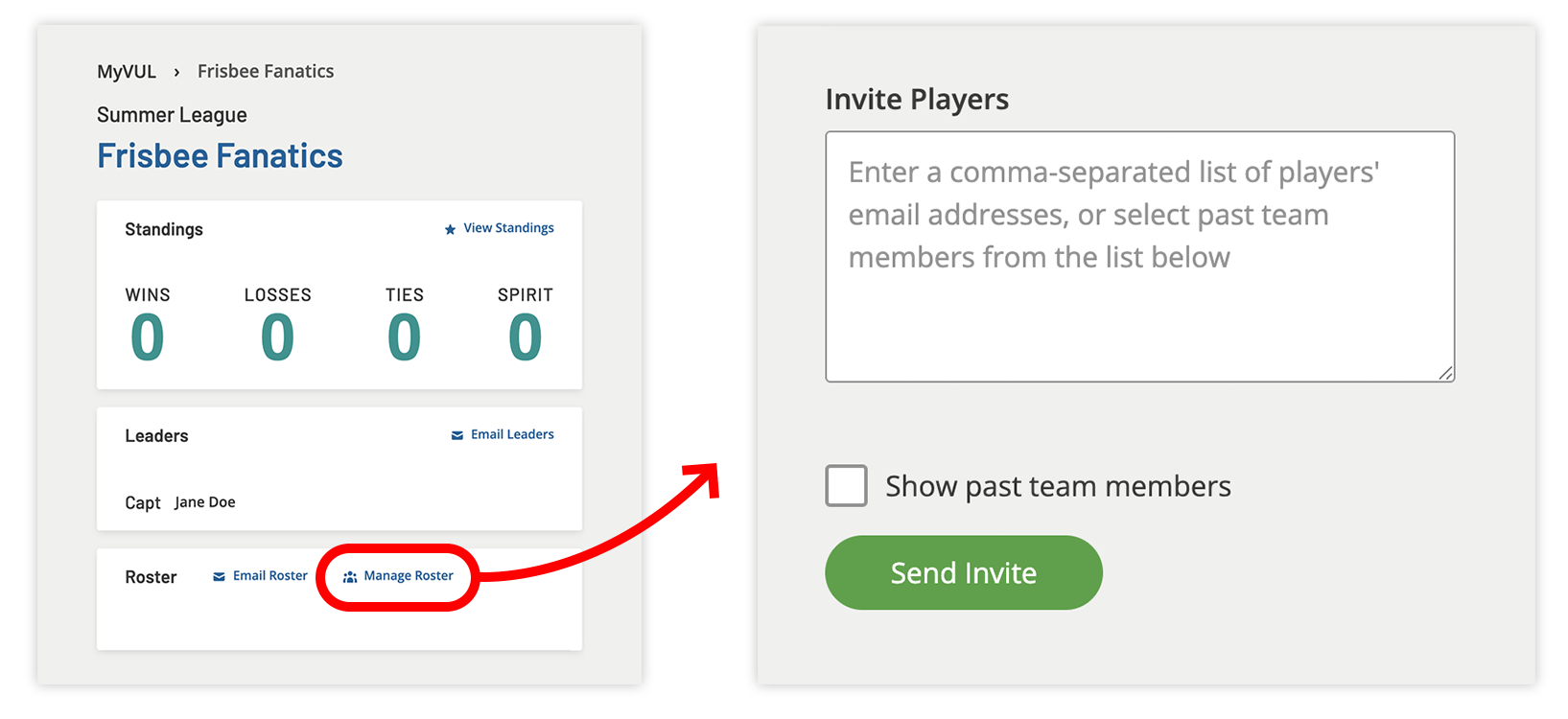
Once your team name is approved, visit myVUL, and click on your team to visit your Team Page. On your team page, you can:
- See all players on your roster, their gender match, and assigned roles
- Invite players to your roster (see below)
- See player attendance (see below)
- See your game schedule
- Submit game reports
Building Your Roster
If you’re forming a new team, start inviting players to your roster soon as possible. You can do this by clicking "Manage Roster" on your team page, then enter email addresses at the box at the bottom of the next page.
Remember that we require a minimum of 12 players on a roster for 7v7 leagues, and 10 players for 5v5 leagues.
Collecting Attendance
Players will get an automated reminder email three days before game days outlining game times and locations. There are also buttons they can click to set their attendance status (attending, absent, unsure)—encourage your team to use this feature to save you time!
Captain’s Meeting
Prior to the start of each season of league play, league organizers will host a Captain’s Meeting to go over all the important information for captains to be aware of. It is important that you attend this meeting to ensure you have all necessary information. If you cannot attend, you must have one of your assistant captains attend in your place
Beginner’s Clinics
As a captain, you’ll likely invite new players from time to time (that’s how we grow the sport!). We offer a few different ways for beginners to develop the skills they need to play. Visit our Learn to Play page for more info.
Most importantly, we host a free Beginner’s Clinic before the first day of select leagues. These 2-hour clinics are intended to give beginners a quick crash course to the sport, including basic rules, throwing, catching, and playing strategy. It’s just enough to prepare players for their very first game. These clinics are free, but players must be on a roster to attend. We share info about date and location with captains after league registration closes.
Seeding and Scheduling
After registration closes, we begin preparing schedules for the first semester.
Useful Terms
| Divisions | In large leagues, groups of teams of similar skill level |
| Double-header | A game day with two back-to-back games |
| Single-header | A game day with one game. In 7v7, a single-header is to 21 points and 110 minutes. See rules. |
| Semesters | A season (typically 10–14 weeks) is split up into 3–4 week periods called semesters. In a semester, you’ll play most teams in your division |
| Playoffs | Playoffs are 1–3 weeks depending on the league. See a sample schedule (times are examples only) |
| Statutory Holidays | Games proceed as normal on statutory holidays or statutory holiday weekends, unless specified by league organizers. If needed, teams may contact their opponent to cancel the games. |
Divisions & Seeding
In programs with sufficient registration, teams are placed into divisions with other teams of similar skill and experience. In Vancouver Summer League, there are 6-8 divisions on each night, so there is a wide variety of competition. In other leagues, there are anywhere from 1-6 divisions in each timeslot, depending on the league.
Divisions can be roughly described as follows:
| Division 1 | Very experienced players (5+ years) and very competitive play |
| Divisions 2–3 | Experienced players (typically 3+ years) and competitive play |
| Divisions 4–5 | Players with some experience and a mix of competitive & recreational play |
| Divisions 6–8 | Players with some or no experience and/or a focus on recreational play |
| These are generalizations, and the actual level of play depends on the teams that actually register to play. | |
For the initial seeding, we consider:
- the division you requested;
- the division you ended in last year (if applicable); and
- the skill level (see below) of your players at the time of registration deadline.
If you are placed in a division that doesn't match what you requested, remember that you should still be in a division with teams of similar skill. We will also re-seed teams between divisions after each semester (see below).
Skill Level
We calculate skill level based on two self-reported factors: how long you’ve been playing ultimate, and the highest level of competitive ultimate you’ve played. These two factors, combined with your age, are used to calculate a skill level compared to other players in the league.
While we do our best to make sure divisions are balanced and competitive, our efforts only go as far as the data we receive. Please remind your team to report your playing history honestly. This helps ensure a fair and enjoyable season for everyone.
Schedules
Schedules are posted one semester at a time. The schedule for the first semester will be posted the week before league starts.
For subsequent semesters, we need to receive game reports for the last week of games before we can re-seed teams and schedule games for the next semester. If we give teams 1-2 days to report scores, that means that schedules will be posted at most 5 days before game day, or 3 or 4 days if some game reports are late.
To ensure your team is re-seeded properly and help us post schedules quickly, submit games reports within 24 hours of your game!
Reseeding
To decide whether to move teams between divisions after a semester, we consider division standings and point differential, what's occurring in divisions above and below, and any special considerations provided by captains. Normally we move the top 1-3 teams up and the bottom 1-3 teams down. However, if a team won or lost all of their games by a small margin, they may be in the best division for them. Conversely, if a few teams in the division are being badly outplayed, we may move teams up to replace them even if the teams moving up would not be moved based on standings alone. It's not an exact science. We do our best to maximize the balance in all divisions so teams can play others of similar skill.
If there is something important that we should take into account during reseeding please contact league organizers.
Conflict Management
Disagreements vs. Disputes
In an Ultimate game, we expect disagreements to occur. A simple example is "foul" and "contest". Everyone will not always have the same point of view. However, we do not expect or want extended arguments, heated disputes, verbal abuse, taunting, or unsafe play.
As a captain, your role in partnership with the other team's captain is to ensure disagreements are resolved before they become disputes or worse. Ensuring your players are familiar with the rules (maybe with guidance from the Rules Guru), and reminding them to ask questions will help them resolve issues on their own. In the cases where your involvement is necessary, you should still support players to reach a resolution themselves, if possible. This may include listening to their perspectives, involving the Rule Gurus, explaining the relevant rules, and using them to reach a resolution.
Most Importantly, BE CALM
- Breathe.
- Explain that you think happened.
- Consider what your opponent thinks happened (everyone has a different perspective, both can be right!).
- Ask others at the field for their point of view (if necessary).
- Listen to what everyone has to say.
- Make a decision.
Spirit of the Game should be a guiding principle in all dispute resolution. Try and follow the course of action that will allow the game to continue in a fun and fair manner.
Resolving Conflicts
If there are any disputes, we ask captains to follow three steps:
- Discuss with the players and other captain at the field.
- If it's not resolved at the field, follow up by phone or email later.
- If it still remains unresolved, contact league organizers.
For all disputes, “resolved” means you are confident that future games with that team will go well.
If disputes between players do escalate beyond a simple disagreement, here are some ways you can help resolve the situation at the field:
- Have the disc go back to the thrower. If there is no agreement that can be made between the players on the field, the disc should go back and play should re-start.
- If that isn't done in a timely manner, coordinate a time-out with the other captain to allow emotions to calm down, if necessary.
- If that still doesn't work (their emotions are too high and/or they are too invested in a particular outcome), pull the players involved off the field, substitute others in their place, and separate the players for a few minutes to calm down.
As soon as reasonably possible (after the point has completed or when the players are calm if they've been subbed off), discuss the dispute to attempt to come to a resolution.
- While remaining as objective and calm as you can, ask each player what they think happened (individually at first if necessary).
- Explain back to them what happened from your understanding, if appropriate. Even if you completely agree with one person, emphasize that it is possible that both are right from their perspectives.
- Remind the players that this is a recreational sport and the most important thing is that we are all enjoying ourselves. The outcome of one point or the game (even if it's playoffs) should be kept in perspective.
- If you managed to do all this and remained calm throughout, chances are very high that your players have now calmed down as well. If possible, have them shake hands.
- Bonus: go for a beer together after the game!
In your game report, you can summarize serious disputes that arose in the game
Game reports
After each game you need to submit an online game report to league organizers. The report includes:
- Game Result - with 4 possible choices:
- Completed: the game was played
- Cancelled: both teams agreed to cancel OR league organizers cancelled the games
- Forfeit: one team cancelled in advance, 48 hours via email OR 24 hours via phone
- Default: one team gives less notice than a forfeit OR they are not able to field a team/play - this results in a $50 fine
- Game Score - Scores help determine reseeding, so be as accurate as possible.
- Carbon Flip - Who won the carbon flip, the default flip for all league games.
- Spirit Score - We capture spirit scores to keep track of games and to recognize spirited teams. Our system is a modified version of the system WFDF uses for tournaments - see below.
- Field Condition - Comments about damage or other issues help us escalate them to the Parks Board, and prevent future hazards at the same field.
- Comments - Did something happen that you'd like us to know about? If so, you can include that in the Comments section at the bottom of the report. You can ask us to follow up with you or the other team if you think it's necessary, and you can choose to send a copy of your comments to the other captain, as well.
You can jump to an outstanding game report using the Reminders on the MyVUL page.
Spirit Score System
There are 4 questions (categories), each with examples of good spirit. For each category captains assess the other team using a 4-point scale (Poor, Fair, Good, Excellent). The categories are:
1. Timeliness. For example: Their team was ready to start on time. They kept to time limits during the game, and help the game end on time.
2. Rules Knowledge & Use. For example: Players understood the rules, or were willing to learn them. They shared their rules knowledge respectfully. They were willing to believe calls were made in good faith. Disagreements were handled quickly and not escalated into arguments. The captain helped resolve disputes (if any).
3. Safe & Clean Play. For example: Players avoided fouling, contact and dangerous plays. The captain addressed concerns about dangerous players on their team. All players exhibited good sportsmanship.
4. Positive Attitude & Communication .For example: They communicated without derogatory or aggressive language. They complimented us on our good plays. The captain was approachable. They made an effort to clarify any misunderstandings on the sideline. They engaged us with an interactive cheer, spirit game, spirit circle, or similar acknowledgement at the end of the game.
For the answer options:
- Save Excellent for things that stand out! (worth 10 points)
- Most games in leagues are "Good" (6.7 points)
- Use "Fair" if there were some issues (3.3 points)
- And "Poor" for serious problems (0 points)
The total spirit score ranges from 0 to 10.
Things to Know at the Field
Field Permits
A big part of your registration fee covers the cost of field permits with the municipalities we play in. Having permits ensures that we have guaranteed access to fields. Sometimes there may be other users on the fields that we have permits for. To ensure you get to play when you are supposed to, it is important for you to know where to find these permits in case there is a dispute over field use with other groups.
Find field permits at vul.ca/permits. This can also be found in the main menu, under Leagues.
Here you will find the links to all our active field permits that you show any groups that are disputing your access to the fields.
Please note that some of our permits are VERY large and contain 100s of bookings—give yourself time and space to find them. You can also use a document search for keywords like field name, date, or time, to help find your specific booking.
Field Information
At the field, you and your team are representing the sport and Vancouver Ultimate:
- Be cooperative and respectful when interacting with other field users (see Permit Conflicts below).
- Show the park respect by not playing if the ground is too wet (see Safety below), by following Turf field rules (see below), and by removing all of your garbage.
- Show neighbours respect by following by-laws, especially those about parking, pets, noise, and liquor.
Safety
Before starting your game, walk the field to check for any potential hazards. Remove them from the field if possible. On grass fields, there may be soil or sand from the Park Board on the sideline to fill small holes, or you can mark them with a cone. Report any problems with the field in your game report.
If grass fields are saturated with water, mud, or snow, teams should not play. Teams will be held responsible for damage to fields during our permitted time. Please review our safety and field closure page for full information.
During the game, if someone accidentally walks onto the field, stop the game and ask them to leave the playing area.
Cones
It is neither team's "responsibility" to set up cones at the field for each game (despite teams labelled 'home/away' on the schedule). It is up to the teams that play to set up a field between the two of them and which team will move to the other side for game two (in double header situations). If you cannot decide who is going to move or set up a field, we suggest a disc flip for it.
Permit Conflicts
We have field permits for all of our games, but the fields may be used by others before or after us. Some guidelines for interacting with others:
- For turf fields, do not enter the fenced playing area before your start time, and ensure you are completely off the fields before the end time.
- For all fields, if it doesn't look like the previous group will end on time:
- Find their organizer and give them a 5-minute heads-up.
- Show them our permit on your phone if needed (see above). The booking systems don't allow double-bookings, so if they say they have a permit, one of us made an error.
- If they refuse to leave, in Vancouver call 311 for a Park Ranger, in Surrey call 604-543-6700, or call the police if you feel unsafe.
- Report any issues in your game report afterwards.
Turf Fields
A reminder for artificial turf fields: NO bikes, dogs, food, drinks, tents, or BBQ's are allowed on the field (only water). Please lock your bikes up to a perimeter fence, and leave your dog at home for that night.
See the Park Board's AT Field Terms & Conditions.
Alcohol
Remember that consumption of alcohol is not permitted at any Vancouver Ultimate games, regardless of municipal bylaws that may allow for alcohol in parks.
Captain’s Checklist for Success
Finally, we have our Captain’s Checklist for Success, which is a series of things you can do with your team to help everyone enjoy their time on your team even more.
Questions?
Contact league organizers, and we'll be happy to help.