
October 6, 2025
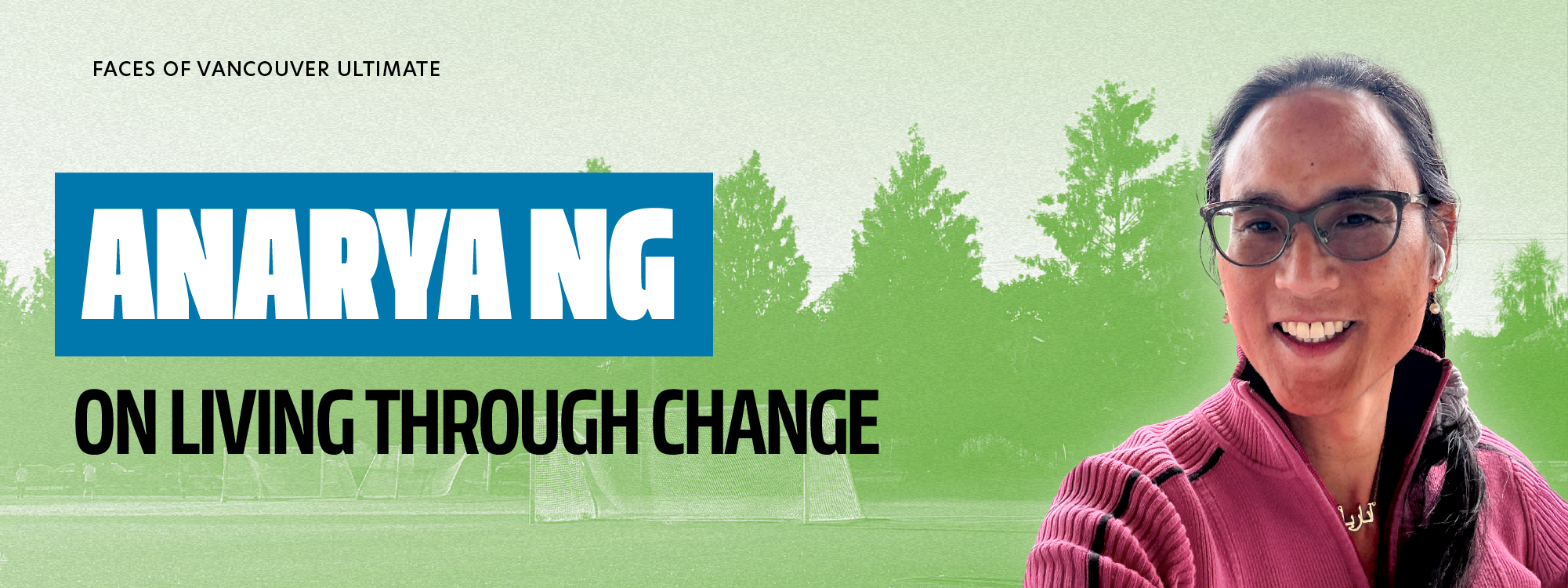
Faces of Vancouver Ultimate is a new series that highlights the people who make our community thrive. In this first feature, VUL Executive Director Rhonda Frizzell sat down with long time player Anarya Ng to talk about her journey with the sport, the role ultimate has played in her life, and her hopes for its future.
Responses have been lightly edited for clarity and flow while preserving the speaker’s original meaning and voice.
Rhonda
Welcome to our first interview for Faces of Vancouver Ultimate. Vancouver Ultimate is one of the largest local playing organizations in the world. We feel a very great sense of commitment to what we do, and see this as a platform and an opportunity to be able to elevate some important discussions about the sport, its people, and our shared culture.
Anarya was first to answer our call out, and we’re really happy to have the chance to chat.
Anarya
Thank you so much, Rhonda. I'll start with a very quick story:
I was living in San Diego—I had just moved back from living overseas for a while. I got a new job in a new company, and then started looking for some sort of recreation. There was a gal in my new company who was into ultimate, and said, “Oh, you should come to our rec league, and give it a try”. I did, and I was instantly hooked. I thought, wow, this is the thing for me. I only found out years later that that coworker was actually part of Safari, which was the Nationals women's team from San Diego, and she never gave any hint of any of that. She was just trying to get people into this great game.
That was a million years ago, back in the 90s. Since my involvement in San Diego, I played a lot in Seattle and upstate New York, and since moving to Vancouver, been playing for about three and a half years.
I am transgender, and so that means that I played 11 years of ultimate as a male-matching player, and then had a 15-year break in between while I raised my kids, and I've come back playing as a female-matching player. I returned to ultimate during a very tumultuous time in my life. I thought I was long retired from playing, but largely thanks to VUL’s progressive policy towards trans players, I got up the courage to pick it up again. I really appreciate having this organization available to me. It was just happenstance that I wound up in a part of the world that had such a burgeoning scene and committed people.
VUL’s inclusive policy opened the door for me, but stepping through it was still scary. I had a lot of early questioning, like where I belonged in ultimate or even if I did at all.
Ultimate is my exercise. It's my social life. It's my form of meditation and self care. It's my life coping strategy. It's a really big part of my life and so I'm just very happy to have it back. I also wanted to point out that since my return to ultimate, the interactions that I've had on and off field have helped me build and sustain a sense of well being and optimism for humanity. I don't know how much we want to get into current events, but having optimism for humanity is a little bit tougher nowadays.
Rhonda
I appreciate that so much. I've been around for about a year now, but I have to say that my reasons for being attracted to this organization are quite similar to your reasons for being attracted to the sport. There is that wonderful sense of equity in ultimate’s self officiating, which I think is a really beautiful quality. Another thing that really appeals to me is the sense of passion that you're portraying, on a level that you don't often see in the sports arena. It's amazing for me to hear your history and where ultimate comes in.
I'd be curious to know your thoughts on what you see as the future of ultimate, and how we—as an organization—can best support that?
Anarya
At the risk of sounding negative at first—I promise I'm not—I was reading about the recent success of the WNBA, and how it’s really growing in popularity. Some of the stories I was reading were also pointing out the increases in racism, misogyny, and homophobia that came with those larger crowds and broader audience: transphobic vibes coming from some of the arenas and some of the fans, and the negative effect that was having on the player and audience experiences.
I think I see the VUL making great strides in building up the sport. It's amazing what the VUL is doing, particularly with your youth programs and youth competitive divisions. That is all a level of organization that simply did not exist in my earlier playing days, which was very informal. That's all really good, but I do take a bit of a cautionary message from stories like the WNBA’s. With greater appeal comes challenges, right? I would hope, as the VUL continues to grow and reach more and more people—particularly young people—that you will also take a note from the WNBA’s historical focus on seeking justice for those who are marginalized (and being inclusive and unapologetic and loud about our ideals of inclusion and equity). It's that spirit, literally, the spirit of the game that is the number one thing that drew me to the sport in the first place, and that’s unique in the world of sport. I hope we never lose that uniqueness.
Rhonda
I agree we can't be quiet right now. I think we have to be extra vigilant—hyper vigilant—in terms of what's happening in the world and how that impacts us. It's included in our mission, that we're inclusion-based. That's who we are unapologetically as an organization, and that's not going to change.
My next question for you, in terms of your experience and time playing ultimate, what are some changes you’ve observed in the sport?
Anarya
The most obvious change I've seen is that the talent level, the training, and the strategy levels are way up. When I left the sport the first time, people were just starting to talk about horizontal stack and it was, as I said before, looser and not as organized. There was a lot of huck and ‘go get it’ play. It’s been really great to see the way the sport has developed and refined itself. I also think the level of fair play that I see at all levels has been mostly maintained, which I’ve been very happy to see. But I do think ‘spirit of the game’ is not quite as prevalent as I used to see it. For instance, I don't know how much of this is a regional difference and how much that impacts the sport, but post-game cheers used to be a really big deal. It was another level of competition, actually, in terms of how awesome your cheer could be. I can remember the elaborate lyrics of extended multiverse songs, fun choreography, skits and stuff like that. I do think that that has diminished a little bit. I am aware that in league games, time is tight, so sometimes you can't do a full Hollywood production after each point.
One of the big personal changes for me is transitioning from playing open-division to female-matching divisions. When I first came on, VUL’s inclusive policy opened the door for me, but stepping through it was still scary. I had a lot of early questioning, like where I belonged in ultimate—or even if I did at all. This was happening in the larger context of all the trans sports bans and made me dysphoric and questioning. That first season I played, which was the fall league for female-matching players, I was questioning everything about myself and my style of play—the way I was moving, the way I was thinking.
I think I can say now, having experienced both, that the female-matching game is different. It really is. It feels different. In terms of team participation, and definitely in terms of vibes—it’s better. People are way more encouraging and supportive of each other, and that was balm to my soul, especially in that moment of doubt and uncertainty. I felt so welcomed and accepted and not-questioned or looked at with a jaundiced eye. That's really what made me decide to step all the way through and become involved and start playing year round. That first season was very much a tentative foray into something. Again, I can't thank the VUL enough for creating the kind of environment where someone with my background can come back to playing and find acceptance.
Other changes: I've experienced decreases in physical ability. I have to leave it to the experts to know how much of that is due to transition and how much of it is due to advancing age, but I've definitely lost a step or two, and I can't jump anymore. I’ve been trying to keep up on the research, to understand my own body. One thing I can definitely say is due to transition, I've had a massive loss in Max VO2. So now I go out there, I play a point, and I'm sucking wind so hard when I come off—just grateful for the sub. However, I guess to counterbalance those physical losses, I think transition and advancing age have helped me increase some of my mental and emotional abilities. I used to play so nervously, just yearning to be better and berating myself when I wasn’t. With transition and age has come a little less anxiety about how I may look on the field, and that has allowed a greater sense of belonging to gain hold. I feel like I may have played more competitively in my previous life, but the game is so much more fun and fulfilling to me now than it ever was before.
Since my return to ultimate, the interactions that I've had on and off field have helped build and sustain a sense of well being and optimism for humanity
Rhonda
I was thinking about your comment on aging, and I think we have a responsibility as an organization to look at aging and ageism in the way that we run our programming. It's one of the things that's neglected in the way that we look at inclusion. I think it's something we need to pay a little bit more attention to going forward.
I wanted to wrap up our questions by saying that I'm so appreciative of your wonderful words and praise for us, but we also fully acknowledge that there's a lot more we can do. Do you have any ideas for us in terms of your experience, on what we can do better?
Anarya
I wanted to make a point that the open participation of transgender people in sports is raising a bit of a question about why there are female-matching and male-matching divisions at all. My current thinking on that topic is, I don't think those divisions are sacred biological truths. As a comparison, I'm left handed, and being left handed in Ultimate is a significant advantage. If most people force a righty flick by default that leaves the lefty huck wide open. And believe me, I exploit that. It also makes the inside-out pass easier to do with precision and power. But despite that fact, we don't have left hand divisions, right? So I just offer that as a little thought experiment, to stir the pot a little. I think the underlying reason for having divisions is to create safe and meaningful competition. But I think what's been uncovered now is that they're kind of blunt instruments for that goal. Given that, I think some devolution and diversification of our thinking makes sense.
By devolution, I mean that I see some more enlightened sports federations delegating rule-making authority, from the international organizations down to the provincial or local organizations like the VUL for instance. Because they're closer to the actual play that's happening on the field, they can therefore make the most enlightened decisions about how to organize. I think that giving more thought to setting rules according to style of play or level of competition makes a lot of sense. Ultimate has the foot block rule, right? I'm thinking of maybe expanding on that concept a bit to match the constraints of the game to the competition level.
Rules are different for different age divisions or within different leagues, right? For instance, I was so happy when somebody introduced me to indoor ultimate. It's so much fun. You can play and not get rained on or blown away. What I noticed is that the way that game has evolved, at least at the VUL, is that there's this natural definition of roles that get mapped onto gender roles. So typically, I've played five on five: three male-matching, two female-matching, and the female-matching ones are the markers. They'd make a cup at the beginning, and then the guys are downfield, looking for the big run through defence to stop the huck. That's the first time I'd ever played ultimate with that kind of organization, and I noticed that it played to everybody's strengths. It has me wondering if that concept is applicable in other ultimate situations as well.
I'll end with a quote that has stuck in my head ever since I saw it. It's from an activist I follow, Andrea Chalupa: “In an age of cruelty, empathy is an act of rebellion”.
I see what we're doing as exactly that. I see the work you guys are doing is part of that battle. I see my own personal life course as part of that battle. I am about to start going to school again (at my age!) to learn to be a counselor, because that's what I decided I wanted to do with the third act of my life. I see that as an example of creating empathy in an age of cruelty.
Faces of Vancouver Ultimate is a storytelling series that spotlights the people who shape our community and culture. Through personal stories and honest reflections, it explores what ultimate means to those who play, coach, and lead in Metro Vancouver.
Have a story to tell? Let us know.